
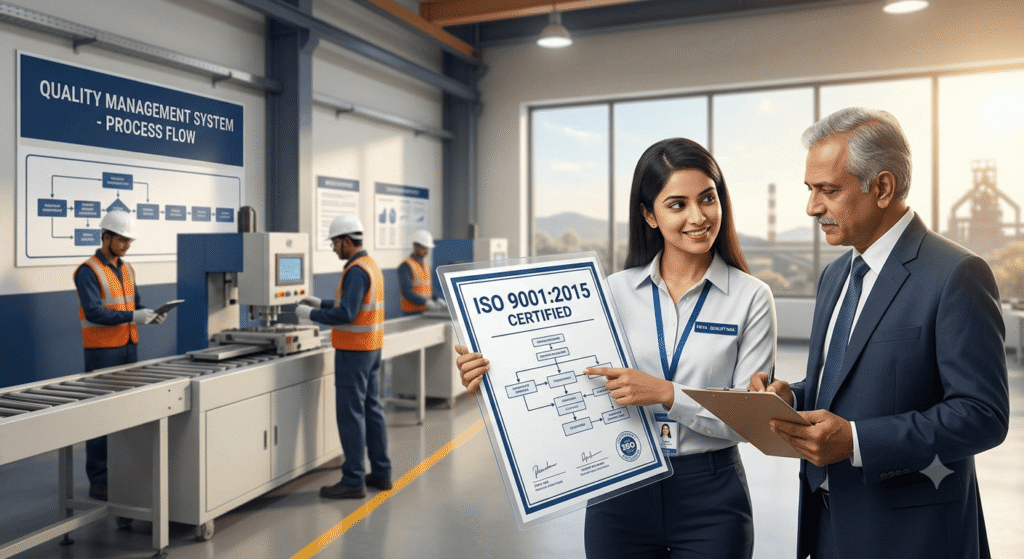
If you are a business owner in India looking to scale, secure government tenders, or attract international clients, you have probably been told you need ISO 9001. But diving into the world of quality standards can feel like swimming in a ISO 9001 certification in India of acronyms, hidden fees, and confusing jargon.
Whether you are a startup trying to build credibility or an established manufacturer aiming to streamline your operations, this guide will break down exactly what you need to know. We will cover everything from the step-by-step process to the real costs involved, stripping away the fluff so you can make informed, cost-effective decisions for your business.
What is ISO 9001 Certification in India?
At its core, ISO 9001 certification in India is a globally recognized stamp of approval proving that your organization has a robust Quality Management System (QMS) in place. It tells your clients, partners, and stakeholders that you are committed to delivering consistent quality, continuously improving your processes, and actively managing operational risks.
In the highly competitive Indian market, holding an ISO 9001 certificate has shifted from being a “nice-to-have” to a strict business prerequisite. You will frequently need it for:
- Government Contracts: Participating in tenders on the GeM portal, state PWD, or Railways.
- Corporate Empanelment: Becoming an approved vendor for large conglomerates like Tata, Reliance, Adani, or Maruti Suzuki.
- Global Exporting: Meeting the stringent compliance demands of buyers in the EU, US, and Middle Eastern markets.
Expert Tip: Always ensure your certificate is issued by an IAF (International Accreditation Forum) (ISO 9001 certification in India)or NABCB-accredited certification body. Ultra-cheap, non-accredited certificates might save you a few thousand rupees today, but they are virtually worthless and are routinely rejected by government portals and major corporate buyers.
How to Get ISO 9001 Certification
Many businesses mistakenly assume that buying a certificate is just a paperwork exercise. In reality, it is about aligning your daily operations with international quality standards.
Here is the exact roadmap on how to get ISO 9001 certification (ISO 9001 certification in India) without disrupting your entire business:
1.Gap Analysis & Planning:Assess your current state.
Before changing anything, you or your consultant will compare your existing business processes against the ISO 9001 requirements. This identifies the operational “gaps” you need to fill to reach compliance.
2.Documentation & QMS Design:Keep it practical.
Develop your Quality Manual, Standard Operating Procedures (SOPs), and quality policies. Do not overcomplicate this. The goal is to create clear, actionable guidelines for your team, not a 500-page theoretical document.
3.Implementation & Training:Put it into practice.
Roll out the new procedures across your organization. Train your employees on the new standards so everyone understands their specific role in maintaining quality and tracking metrics.
4.Internal Audit & Management Review:Your trial run.
Conduct a self-check (internal audit) to ensure your new QMS is actually working in the real world. Your management team reviews the findings and fixes any non-conformities before the official auditors arrive.
5.External Audit (Stage 1 & Stage 2):The final test.
An external certification body will review your documentation (Stage 1) and then visit your facility to assess your actual operational compliance (Stage 2). If you pass both stages, they issue your official ISO 9001 certificate! $ ISO 9001 certification in India.
The Big Question: ISO 9001 Certification Cost
If you have asked for quotes related to ISO 9001 certification in India, you have probably received numbers ranging from suspiciously cheap to overwhelmingly expensive. The truth is, there is no single flat rate.
The Iso 9001 certification cost depends heavily on your business size, number of locations, industry complexity, and whether you hire a consultant to help you build the QMS.
Here is a realistic breakdown of total costs (including both consulting and audit fees) for Indian businesses in 2026:
| Business Size | Employee Count | Estimated Total Cost (INR) |
| Micro / Startup | 1–10 | ₹8,000 – ₹18,000 |
| Small / MSME | 11–50 | ₹18,000 – ₹45,000 |
| Medium Enterprise | 51–200 | ₹45,000 – ₹1,10,000 |
| Large Enterprise | 200+ | ₹1,10,000 – ₹3,50,000+ |
Watch out for hidden fees: Many low-ball quotes look attractive upfront but exclude mandatory expenses. Ensure your quote covers internal audit training, certificate printing, and most importantly, the annual surveillance audits required in Year 2 and Year 3 to maintain your active status. Always ask your provider for a comprehensive quote covering the full three-year certification cycle.
The Truth About ISO 9001 Certification for Individuals
Here is a common misconception that trips up many professionals: Organizations get ISO 9001 certified, not individual people.
If you are a professional looking to boost your resume, you cannot get an “ISO 9001 certification in India” for yourself. However, you can pursue ISO 9001 certification for individuals in the form of specialized auditor training.
These powerful credentials give you the authority to implement the standard from the inside or audit other companies professionally:
- Internal Auditor Training: Ideal for quality managers, HR professionals, and operational staff who want to manage their own company’s QMS and conduct internal checks. (Typical cost: ₹5,000 to ₹15,000).(ISO 9001 certification in India).
- Lead Auditor Certification: Designed for professionals who want to conduct official, third-party audits on behalf of certification bodies (accredited by bodies like CQI-IRCA or PECB). This involves rigorous training and examinations. (Typical cost: ₹20,000 to ₹35,000).
Investing in individual training is highly lucrative—skilled Lead Auditors are constantly in demand as thousands of Indian companies seek compliance every year.
Achieving ISO 9001 (ISO 9001 certification in India)compliance is an investment in your company’s operational excellence and market reputation. By understanding the true costs, avoiding non-accredited shortcuts, and following a structured implementation plan, you can turn a daunting compliance task into a powerful engine for business growth.